Plaster, drywall and ceilings · Lake County
Drywall Repair in East Chicago, IN
Cracked plaster, holes in drywall, leak-stained ceilings and rental walls worn down by the last tenant, repaired, blended into the surface around them and handed back paint-ready.
Once you call, a local drywall pro rings you back to talk through the wall and arrange a quote before anything is opened up.
Call 7 days, 7am–9pm
One crack or a single doorknob dent is worth a call; small jobs are welcome.
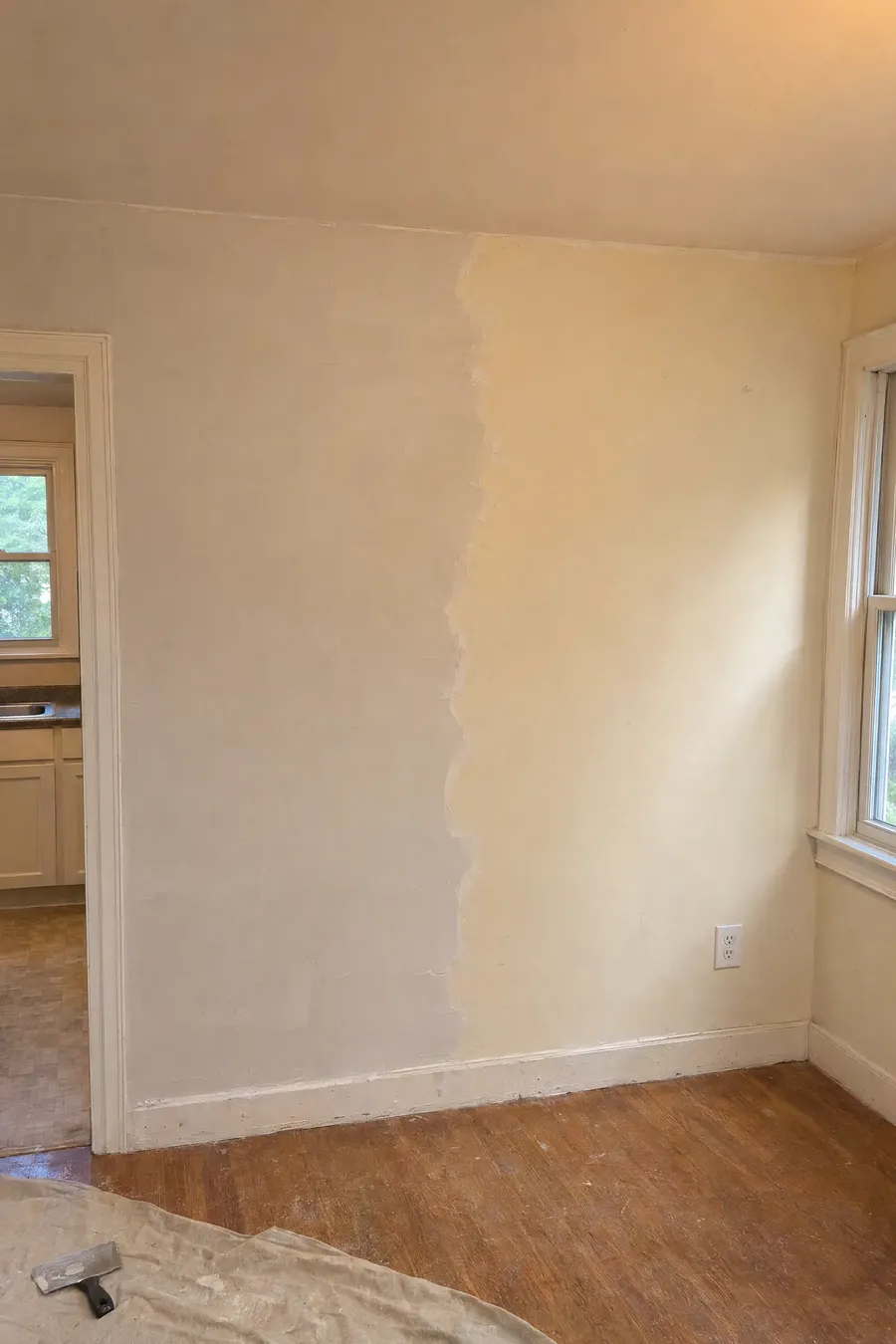
Why can I still see a patch after the wall has been painted?
It is a fair question, and the answer usually has less to do with the paint than with what is under it.
Think of the wall as a sponge with patches of different thirst. Fresh joint compound soaks up paint faster than the old painted surface around it, so the first coat dries flatter and duller over the repair. In light coming sideways from a window, that dull square shows up like a shadow. Painters call it flashing, and it explains most patches that still show after painting.
A proper finish deals with it in three steps. First, the compound is sanded flush and wiped free of dust. Then the patch, plus a margin of a few inches around it, gets a coat of primer, which evens out how much the surface drinks. Finally the color goes on, matching the wall's existing sheen, ideally rolled from corner to corner instead of dabbed onto the spot.
Sheen matters more than most people expect. Flat paint hides small ripples; eggshell and satin show them, because a shinier surface reflects light off every bump. If your walls are satin, the repair needs to be smoother than it would under flat paint.
Who paints depends on you. Some people want the wall left primed so their own painter can finish the room; others want it brought all the way back to color. Mention your preference on the call, and the quote is written that way. If you still have the old paint can, keep it: the lid or label usually names the color and sheen.
Who closes up the openings an electrician or plumber leaves behind?
Older houses get rewired, replumbed and fitted with new heating runs, and each of those trades usually has to open the wall to reach what is behind it. An electrician fishing a new circuit may cut a row of small openings high up, near the ceiling line. A plumber chasing a drip may take out a square of ceiling under a bathroom. Those trades are rarely hired to close the openings again, and that is normal.
That is the part we book. First, wait until the work behind the wall is finished and, if the job needed a permit, until it has been signed off; closing a wall too early can mean cutting it open a second time. Then the hole is trimmed square, given wood backing where there is nothing solid to screw into, and filled with board cut to the thickness of the wall. In a plaster house that often means layering thinner sheets so the filler board ends level with the older, thicker surface. Finally the seams are taped, coated and feathered out so the edges fade into the wall.
One tip if trade work is still ahead of you: ask for clean, square cuts. A neat rectangle is simpler to close than a ragged hole with cracks running off its corners, and it usually costs less to finish.
Which kinds of wall and ceiling damage can be booked here?
Every repair type gets a separate page that covers the causes, the method behind a sound repair, and what to ask before booking.
- Plaster Crack RepairCracks, bulges and holes in old plaster-and-lath walls and ceilings, re-attached and repaired in place, or cut out and filled with drywall.
- Ceiling Water Damage RepairStained, soft or sagging ceilings after a roof leak, a dripping pipe or a line that froze and split, trimmed back to solid board and rebuilt.
- Drywall Hole PatchingDoorknob holes, anchor holes and the openings plumbers and electricians leave behind, backed, patched and blended into the wall.
- Rental Turnover RepairWall and ceiling patching between tenants, sequenced so the painter can follow and the unit can be shown.
The same four are also gathered on a single list of repairs.
Moving out, re-renting or listing the house: what is worth fixing first?
Before a landlord's final check of a unit or a listing photo shoot, walls are judged in a few seconds, usually from the doorway. That tells you where to spend. From the doorway a person notices holes, dents beside door handles, broken outside corners and ceiling stains. They rarely notice a fine hairline high on a wall or a handful of nail holes that one coat of paint will hide.
At the 2020 census, East Chicago's housing stock stood at 11,735 units, 16.0% of them empty. When an empty unit is readied for a new tenant or buyer, its walls are usually near the top of the list, and the sequence matters.
- Repairs first. Patching makes dust and needs primer, so it goes ahead of everything else.
- Painting second. If a painter is already booked, mention the date when you call so the repairs can be dry and primed before then.
- Cleaning last. Floors and windowsills are cleaned once the sanding dust has settled.
Furniture can stay if it can be moved a few feet from the wall. Pictures, shelves and TV mounts are best taken down beforehand, so their holes can be filled along with the rest.
Plaster or drywall, and which texture: how do you tell?
East Chicago grew fast. It had 3,411 residents in 1900, more than 24,000 by 1910, and reached its peak of 57,669 in 1960. A great deal of the city's housing went up during those decades, and houses built before drywall became the normal finish were usually plastered over thin strips of wood called lath. So the first thing worth knowing is which kind of wall you have.
Here is an easy test. Knock between the studs. Drywall sounds hollow and a little papery; plaster sounds dull and solid and feels cold and hard. Another clue: push a pushpin into a closet wall. It slides into drywall with little effort and stops almost at once in plaster.
Next comes the surface. Most walls and ceilings carry one of the five finishes drawn below. A repair copies a texture by using the same method that made it: thinned compound sprayed or rolled for orange peel, spatters knocked flat with a broad blade for knockdown, a curved trowel swept across for skip trowel, and a sprayed product for popcorn ceilings. Smooth walls simply get more careful sanding. Trying the spray on a scrap of board before touching the wall is a normal way to get the spatter size right.
- Smooth
- Orange peel
- Knockdown
- Skip trowel
- Popcorn
For the boards, compounds and tapes themselves, the plain-language materials guide goes into more depth.
Should old plaster be repaired in place, or cut out and replaced with drywall?
There is no single right answer, and a fair quote can explain more than one option. The table compares three common approaches for a damaged plaster wall on five plain points, and the chart after it sums up how each one handles four common situations.
| Repair the plaster in place | Cut out and fill with drywall | Skim coat the whole wall | |
|---|---|---|---|
| Best for | Cracks and small loose areas where most of the plaster is still tight to the lath | Holes, crumbling sections and areas soaked by a leak | Walls covered in fine cracks or a rough, patched-over surface |
| Dust and mess | Low to moderate, as little is removed | Highest, because old plaster and lath come out | Moderate, mostly from sanding |
| Time involved | Shortest for small areas | Longer: removal, fitting the board, then the coats | Longest per wall, because every square foot is coated |
| Matching the old wall | Keeps the original surface and its gentle waves | Needs shims or layered board to reach the depth of the thicker plaster | Gives one even new surface, so nothing has to blend |
| What drives the price | How much plaster is loose and has to be re-attached | Size of the cut-out and the depth to build up | Wall area and how rough the starting surface is |
handles it well partly poorly
What actually happens on the day the wall is repaired?
Most repairs follow the same five stages, and knowing them makes the day less of a mystery.
- Protecting the room. The room comes first: drop cloths on the floor, furniture shifted away from the wall and, for dusty work, plastic over the doorway so the dust stays in one room. Clearing a strip about four feet wide along the damaged wall beforehand helps.
- Opening up or prepping. Loose plaster is scraped back to firm edges, soaked board is removed, or a crack is widened into a slight groove so the filler can key in. Notice that the damage often looks bigger at this stage. That is normal: the repair has to reach sound material.
- Coats. The first coat fills the gap and beds the tape or mesh. Then come one or two thinner, wider coats that feather the edges outward, each spreading a little past the last, a bit like ripples spreading from a stone.
- Drying. Setting compound hardens by a chemical reaction in a time printed on the bag. Premixed compound has to give up its water to the air, which can take a full night in a cold, damp room. That is why many repairs stretch over two or more days even when the actual working time is short.
- Sanding and priming. Once the final coat is smoothed with sandpaper and the dust wiped off, the patch is primed or painted, depending on what was quoted. It is worth asking how the sanding dust gets contained; vacuum-assisted sanding or a wet sponge keeps far less of it in the air.
For the whole booking, from the first phone call to the primed wall, see how a repair is arranged.
How much does a wall or ceiling repair usually cost?
National cost guides make a useful yardstick. Fixr's drywall repair guide, last updated January 31, 2025, puts the national average range for a drywall repair job at $200 to $550, and lists $60 to $330 for a crack, $60 to $200 for a hole, and about $400 to $800 for water damage across one room's walls or ceiling. Fixr's plaster guide puts plaster repair between $50 and $120 for each square foot. These are countrywide numbers rather than East Chicago prices, and your own quote depends on your own wall.
Six things usually make a repair bigger or smaller:
- Size and count. Several holes in one room are usually cheaper together than booked one at a time.
- Wall or ceiling. Working overhead takes ladders, more protection and more time, so the same size patch costs more on a ceiling.
- Plaster or drywall. Plaster often has to be re-attached or built up to depth before it can be finished.
- Texture. A smooth wall needs more sanding; knockdown and orange peel need to be copied.
- Moisture. A leak has to be stopped and the framing dry before replacement board is fastened in place. Soaked board comes out; covering it over only hides the problem.
- Paint. Primed only, the patch painted, or the whole wall rolled: each is priced differently.
Which towns around East Chicago are covered?
Both halves of East Chicago, the Indiana Harbor side and the West Side, plus six neighbors in Lake County.
- Hammond, the neighbor to the west and one of the oldest cities in northern Lake County.
- Whiting, a few miles northwest on the Lake Michigan shore.
- Gary, whose northwest corner borders East Chicago.
- Highland, the town directly south, with Hammond on its northern edge.
- Munster, south-southwest, known locally as the Town on the Ridge.
- Griffith, to the south-southeast, where Cline Avenue runs north toward East Chicago.
Is cracking in a newer drywall house a different problem?
Usually, yes. Not every home in and around East Chicago is old, and a house finished in drywall moves in its own ways. Three patterns are worth recognizing.
Nail pops
These are small round bumps or cracks in a neat line over a stud. Framing lumber shrinks as it dries out during its first heating seasons, and the nail head is left standing proud. The usual fix is a drywall screw driven just beside the nail, drawing the board snug against the stud, the old nail set below the surface, and the spot coated and primed. Fixr lists nail pop repair at $75 to $140 nationally.
Ceiling-to-wall cracks that come and go
A crack where the ceiling meets an inside wall, widening each winter and tightening again by summer, is often truss uplift. Roof trusses bow slightly upward when the attic is cold and dry, and the ceiling rises with them. Filling the crack does not stop the movement, so the usual answer is to let the ceiling float: fasteners close to the wall are left out, or the corner is covered with a molding fixed to the ceiling only.
Settling cracks at doors and windows
Short diagonal cracks off the corners of openings are normal while a newer house settles. If they stay thin and stop growing, they are cosmetic and can be taped and finished. If a door starts sticking or a crack widens past about a quarter inch, have someone assess the framing or foundation before any patching is done.
Which wall would you like taken care of first?
Say what went wrong and where. A sentence or two, plus a photo if you have one, is enough to start.
When you reach out, a pro from around Lake County gets back to you, hears the story and prices the job.